
Understanding 3-phase contactor wiring, often found in downloadable PDFs, is crucial for controlling motors effectively using start and stop circuits for reliable operation.
What is a 3-Phase Contactor?
A 3-phase contactor is an electrically controlled switch used to frequently switch on and off an electrical circuit. Crucially, it’s designed to handle the higher power demands of three-phase systems, commonly found in industrial applications like motor control. These contactors, often detailed in 3-phase contactor wiring diagram start stop PDFs, utilize electromagnetic coils to open or close contacts, enabling remote operation.
Unlike manual switches, contactors offer reliability and speed, vital for automated processes. A typical start-stop circuit, illustrated in these diagrams, employs push buttons to energize the contactor coil, closing the power circuit and initiating motor operation. When the stop button is pressed, the coil de-energizes, breaking the circuit. Understanding the contactor’s role is fundamental to interpreting wiring diagrams and ensuring safe, efficient motor control.
Importance of Wiring Diagrams
Wiring diagrams, particularly 3-phase contactor wiring diagram start stop PDFs, are absolutely essential for safe and correct installation. They visually represent the connections between components – the power supply, contactor coil, start/stop buttons, and thermal overload relay – minimizing errors and potential hazards. Attempting to wire a 3-phase system without a diagram is strongly discouraged due to the complexity and high voltages involved.
These diagrams aren’t just for professionals; DIYers can also successfully complete installations with careful study and adherence to the provided schematics. A clear diagram ensures proper functionality, including the holding circuit created by auxiliary contacts, and the integration of safety features like emergency stop buttons. Accessing free PDFs and online tutorials further simplifies the process, promoting understanding and preventing costly mistakes.

Components of a 3-Phase Contactor System
Essential parts include the power supply, contactor coil, start/stop buttons, auxiliary contacts, and thermal overload relay, all detailed in start/stop PDFs.

3-Phase Power Supply
The foundation of any 3-phase contactor system is a stable and correctly configured 3-phase power supply. Wiring diagrams, particularly those found in start/stop PDFs, clearly illustrate how this power source connects to the contactor’s input terminals. Typically, this involves three hot wires (often labeled L1, L2, and L3) and a neutral wire, though the neutral isn’t always utilized depending on the motor and system configuration.
Proper voltage levels are paramount; the power supply must match the voltage rating of both the motor and the contactor. Incorrect voltage can lead to immediate damage or reduced performance. The PDF diagrams emphasize the importance of secure connections and appropriate wire gauge to handle the current demands of the motor. Safety precautions, like proper grounding, are also highlighted within these resources to prevent electrical hazards during installation and operation.
Contactor Coil
The contactor coil is the electromagnetic heart of the system, energized to close the main power contacts and activate the motor. 3-phase contactor wiring diagrams, especially those in start/stop PDFs, detail how the coil receives power from the control circuit, typically a lower voltage DC source. This control voltage is activated by the start and stop push buttons.

PDF guides emphasize matching the coil voltage to the control circuit’s power supply. Incorrect voltage can prevent the coil from energizing or cause it to overheat. The diagrams illustrate connecting the coil to the start button via auxiliary contacts for a “holding circuit,” maintaining power to the coil even after the start button is released. Understanding coil resistance and current draw is crucial for proper fuse sizing and overall system protection, as detailed in these resources.
Start and Stop Push Buttons
Start and stop push buttons are the primary interface for controlling the motor, and their wiring is central to any 3-phase contactor diagram, particularly those available as PDFs. These buttons initiate and terminate power flow to the contactor coil within the control circuit. Start/stop PDFs clearly show the normally open (NO) configuration typically used for the start button, momentarily energizing the coil.
The stop button is usually normally closed (NC), breaking the circuit when pressed, immediately de-energizing the contactor. Wiring diagrams emphasize the importance of a direct connection from the stop button to the contactor coil for safety, allowing immediate shutdown. These PDFs often illustrate using auxiliary contacts to create a “holding circuit” after the start button is released, ensuring continuous operation until the stop button is pressed.
Auxiliary Contacts
Auxiliary contacts are integral components in 3-phase contactor circuits, frequently detailed in start/stop wiring diagram PDFs. These contacts provide a means to create holding circuits, feedback signals, and interlocks, enhancing control and safety. PDFs demonstrate how normally open (NO) auxiliary contacts, connected in parallel with the start button, maintain the contactor’s energized state after the initial push.
This “latching” function eliminates the need to continuously hold the start button, improving operational convenience. Conversely, normally closed (NC) auxiliary contacts can be used for safety interlocks, shutting down the system if a fault occurs. Detailed PDFs often showcase multiple auxiliary contact configurations for advanced control schemes, including signaling and status indication, crucial for complex motor control applications;
Thermal Overload Relay
The thermal overload relay is a critical safety device, prominently featured in 3-phase contactor wiring diagram PDFs, protecting motors from damage due to excessive current. These relays monitor motor current and trip the control circuit if an overload condition persists, preventing winding burnout. PDFs illustrate wiring the relay in series with the contactor coil, ensuring the motor is de-energized during an overload.
Adjustment of the relay’s trip current is essential, matching the motor’s full-load amps (FLA) as specified on the motor nameplate. Detailed PDFs often include charts and guidelines for proper setting. Automatic or manual reset options are available, with automatic reset requiring careful consideration to avoid nuisance tripping. Proper integration, as shown in wiring diagrams, is vital for reliable motor protection.

Basic Start-Stop Wiring Diagram
Essential PDFs detail a simple circuit: push buttons control a contactor coil, initiating or interrupting power to the 3-phase motor for start/stop functions.
Power Circuit Wiring
The power circuit, detailed in 3-phase contactor wiring diagram PDFs, handles the high-voltage, high-current connection to the motor. Typically, the three-phase power supply connects directly to the contactor’s main power terminals – often labeled T1, T2, and T3. From these terminals, wires run to the motor’s corresponding terminals.
Crucially, wire sizing must match the motor’s full-load amperage (FLA) to prevent overheating and ensure safe operation. The PDF diagrams emphasize proper grounding of the motor frame and conduit for safety. Fuses or circuit breakers are essential components, placed in series with the power supply to protect against short circuits and overloads.
Remember to disconnect power before working on the power circuit, and always verify correct voltage and phase sequence before energizing the system.
Control Circuit Wiring
The control circuit, clearly illustrated in a 3-phase contactor wiring diagram PDF, operates at low voltage (typically 24VDC or 120VAC) and governs the contactor’s operation. Start and stop push buttons are wired in series with the contactor coil. Pressing the start button energizes the coil, pulling in the contactor and establishing the motor circuit.
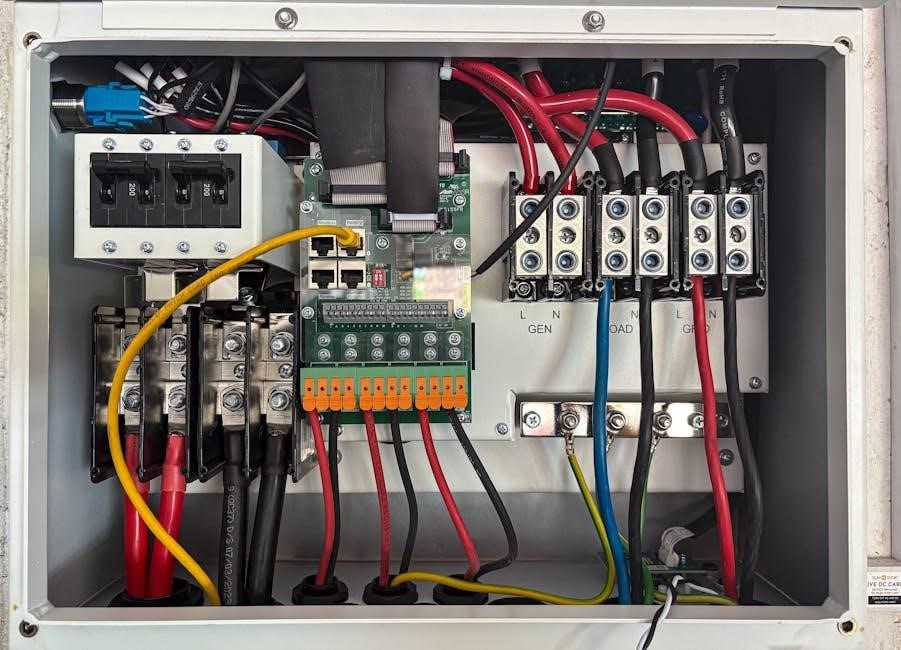
A normally open (NO) auxiliary contact is often used for “holding” or “latching” the contactor closed after the start button is released, as shown in many PDFs. The stop button, when pressed, breaks the circuit, de-energizing the coil and stopping the motor.
Thermal overload relays are integrated into this circuit for motor protection, tripping the control circuit if an overload occurs.
Wiring with Normally Open (NO) Contacts
Utilizing normally open (NO) auxiliary contacts, detailed in a 3-phase contactor wiring diagram PDF, is essential for creating a self-holding circuit. Once the start button is pressed, the contactor coil energizes, and its associated NO auxiliary contact closes. This closed contact then bypasses the start button, maintaining power to the coil even after the start button is released.
This “latching” function, clearly depicted in the diagrams, ensures continuous motor operation until the stop button is pressed, breaking the circuit. NO contacts also facilitate interlocking schemes, preventing simultaneous operation of multiple motors.
PDF guides emphasize proper NO contact selection based on voltage and current ratings for reliable operation and safety.

Detailed Wiring Steps
Following a 3-phase contactor wiring diagram PDF, carefully connect power, start/stop buttons, the coil, and overload relay for safe, functional control.
Step 1: Connecting the Power Supply
Begin by safely connecting the three-phase power supply to the designated terminals on the contactor, referencing your 3-phase contactor wiring diagram PDF. Ensure the power is completely disconnected during this process for safety; Typically, these are labeled L1, L2, and L3. Securely tighten all connections to prevent loose wiring and potential hazards. Double-check the voltage rating of the contactor matches your power supply. Improper voltage can damage the contactor.
Next, connect the appropriate grounding wire to the designated grounding terminal on the contactor enclosure, as indicated in the PDF diagram. Proper grounding is essential for safety and preventing electrical shock. Verify all connections are firm and comply with local electrical codes before proceeding to the next step. A clear, accurate wiring diagram PDF is invaluable during this stage.
Step 2: Wiring the Start Button
Referring to your 3-phase contactor wiring diagram PDF, connect one terminal of the start button to one of the control circuit power supply lines – typically L1. The other terminal of the start button then connects to the T1 terminal (or A1) on the contactor coil. This provides the initial power surge to energize the contactor. Ensure the wire gauge is appropriate for the control circuit voltage and current.
Crucially, a normally open (NO) auxiliary contact is often wired in parallel with the start button, as shown in the PDF. This creates a “holding circuit,” allowing the contactor to remain energized even after the start button is released. Securely tighten all connections and verify the wiring matches the diagram before moving forward.
Step 3: Wiring the Stop Button
According to the 3-phase contactor wiring diagram PDF, the stop button is wired to interrupt the power supply to the contactor coil. Connect one terminal of the stop button to the other control circuit power supply line – typically L2. The remaining terminal of the stop button connects directly to the T2 terminal (or A2) of the contactor coil. This creates a break in the circuit when the stop button is pressed, de-energizing the contactor.
Importantly, the stop button is normally closed (NC), meaning it completes the circuit until pressed. This ensures a fail-safe mechanism; if the control wiring is damaged, the motor will stop. Double-check the wiring against the PDF to confirm correct polarity and secure connections for reliable operation.
Step 4: Connecting the Contactor Coil
Referring to the 3-phase contactor wiring diagram PDF, connect one side of the control power supply (typically L1) to the common terminal of the start button. From the normally open (NO) contact of the start button, run a wire to one terminal (T1 or A1) of the contactor coil. The other terminal (T2 or A2) of the contactor coil, as previously established, connects to the normally closed (NC) contact of the stop button.
This configuration ensures that pressing the start button energizes the coil, pulling in the contactor. The auxiliary contact, often used for holding, will be wired later. Secure all connections and verify the voltage rating of the coil matches the control supply for safe and effective operation.
Step 5: Integrating the Thermal Overload Relay
Consulting the 3-phase contactor wiring diagram PDF, integrate the thermal overload relay into the control circuit for motor protection. Connect the power supply (L1) to the input terminal of the thermal overload relay. From the output terminal of the relay, wire to the contactor coil’s T1/A1 terminal, effectively inserting the relay in series with the coil.
This ensures that if an overload occurs, the relay trips, de-energizing the contactor coil and stopping the motor. Properly setting the overload relay’s current rating, matching the motor’s full-load amps, is vital. Secure all connections and test the relay’s functionality before full operation.

Advanced Wiring Configurations
Exploring complex setups from 3-phase contactor wiring diagram PDFs reveals holding circuits, emergency stops, and two-button control for enhanced motor management.
Using Auxiliary Contacts for Holding Circuit
Implementing a holding circuit with auxiliary contacts, detailed in many 3-phase contactor wiring diagram PDFs, ensures the motor continues running after the start button is released. This is achieved by wiring a normally open (NO) auxiliary contact in parallel with the start button. Once the start button is pressed, it energizes the contactor coil, which simultaneously closes the auxiliary contact.
This closed auxiliary contact then maintains the circuit, keeping the contactor energized even when the start button is no longer held. To stop the motor, the stop button breaks the circuit, de-energizing the contactor and opening the auxiliary contact. This self-maintaining circuit eliminates the need to continuously hold the start button, providing convenient and safe motor control. Diagrams clearly illustrate this connection for easy implementation.
Wiring with Emergency Stop Functionality
Integrating an emergency stop (E-stop) into a 3-phase contactor circuit, as shown in detailed wiring diagram PDFs, is paramount for safety. The E-stop button is wired in series with the stop button and the contactor coil’s power supply. This configuration ensures that pressing the E-stop button immediately breaks the control circuit, de-energizing the contactor and halting the motor regardless of the start/stop button positions.
This direct interruption provides a fail-safe mechanism, crucial in hazardous situations. Diagrams emphasize the E-stop’s priority; it overrides all other control functions. Proper implementation, following the PDF’s guidance, guarantees a rapid and reliable shutdown, protecting personnel and equipment. Regularly testing the E-stop functionality is vital for maintaining a safe working environment.
Two-Button Start/Stop Wiring
Utilizing a two-button start/stop configuration, detailed in 3-phase contactor wiring diagram PDFs, offers enhanced control and safety. This method employs separate buttons for initiating and halting motor operation, preventing accidental starts. The start button momentarily energizes the contactor coil, while an auxiliary contact maintains the circuit once engaged – a ‘holding circuit’.
Pressing the stop button breaks this holding circuit, de-energizing the contactor. Diagrams clearly illustrate the wiring sequence, emphasizing the normally open (NO) auxiliary contact’s role. This setup provides a robust and intuitive control scheme, commonly found in industrial applications. Following the PDF’s instructions ensures correct implementation and reliable operation, minimizing downtime and maximizing safety.

Troubleshooting Common Issues
Referencing a 3-phase contactor wiring diagram PDF aids in diagnosing problems like non-energizing contactors, motor failures, or tripped overload relays efficiently.
Contactor Not Energizing
When a 3-phase contactor fails to energize, consulting a wiring diagram PDF is the first step towards effective troubleshooting. Verify the control voltage supply reaching the contactor coil; a lack of voltage is a primary cause. Inspect the start and stop push buttons for continuity, ensuring they aren’t faulty or wired incorrectly according to the diagram.
Check for open circuits within the control wiring, utilizing a multimeter to trace the path from the power source to the coil. Examine auxiliary contacts, if present, to confirm they are closing properly. A tripped overload relay can also prevent energization – reset it and retest. Finally, confirm the contactor coil itself isn’t damaged; a burned-out coil requires replacement, referencing the PDF for correct specifications.
Motor Not Starting
If the contactor energizes but the motor doesn’t start, a 3-phase contactor wiring diagram PDF becomes invaluable for systematic diagnosis. First, confirm the main power supply to the contactor is present and within acceptable voltage limits. Inspect the contactor’s power contacts for signs of wear, pitting, or loose connections – these must be secure for proper current flow.
Verify the thermal overload relay hasn’t tripped; a reset is needed if it has. Check the motor itself for any mechanical issues, like a jammed rotor or broken windings; Utilize the wiring diagram to trace the power path to the motor, ensuring all connections are tight and correct. A faulty auxiliary contact preventing full circuit completion is also a possibility, requiring diagram-assisted verification.
Overload Relay Tripping
Frequent tripping of the thermal overload relay, as detailed in a 3-phase contactor wiring diagram PDF, signals an issue requiring immediate attention. This often indicates the motor is drawing excessive current, potentially due to an overloaded mechanical load or internal motor faults. First, verify the overload relay’s current setting matches the motor’s nameplate full-load amps (FLA).
Inspect the driven equipment for binding or excessive friction, which could cause the motor to work harder. If the problem persists, suspect internal motor winding issues like shorts or open circuits. A wiring diagram helps trace the relay’s connections, ensuring correct installation and operation. Repeated tripping necessitates a thorough motor inspection by a qualified technician to prevent damage.

Resources and PDF Downloads
Access free 3-phase contactor wiring diagram PDFs for start-stop circuits, offering valuable visuals for electricians and DIY enthusiasts to simplify installations.
Free Wiring Diagram PDFs
Numerous online resources offer freely downloadable PDF wiring diagrams specifically for 3-phase contactor start-stop circuits. These diagrams are invaluable for both seasoned electricians and those undertaking DIY motor control projects. They visually represent the connections between the power supply, contactor coil, start and stop push buttons, auxiliary contacts, and thermal overload relay.
Searching for “3 phase contactor wiring diagram start stop pdf” will yield a variety of options, ranging from basic starter schematics to more complex configurations including holding circuits and emergency stop functionality. Many electrical equipment manufacturers also provide downloadable PDFs for their specific contactor models. These PDFs often include detailed explanations alongside the diagrams, ensuring clarity and safe installation practices. Utilizing these resources can significantly reduce errors and ensure a properly functioning motor control system.
Online Tutorials and Guides
Complementing free PDF wiring diagrams, a wealth of online tutorials and guides are available to assist with 3-phase contactor wiring, particularly for start-stop applications. Video tutorials, often found on platforms like YouTube, provide step-by-step visual demonstrations of the wiring process, making it easier to understand complex connections.
These resources frequently cover topics like identifying contactor terminals, wiring the control circuit, and integrating safety features like emergency stop buttons and overload protection. Many guides also explain the function of auxiliary contacts and how to implement holding circuits. Searching for “3 phase contactor wiring tutorial” or “DOL starter wiring” will reveal numerous helpful resources. Combining these guides with downloadable PDFs ensures a comprehensive understanding and successful implementation of your 3-phase motor control system.